

The Journal
Why Do Some Botanical Oils Stay Fresh Longer Than Others?
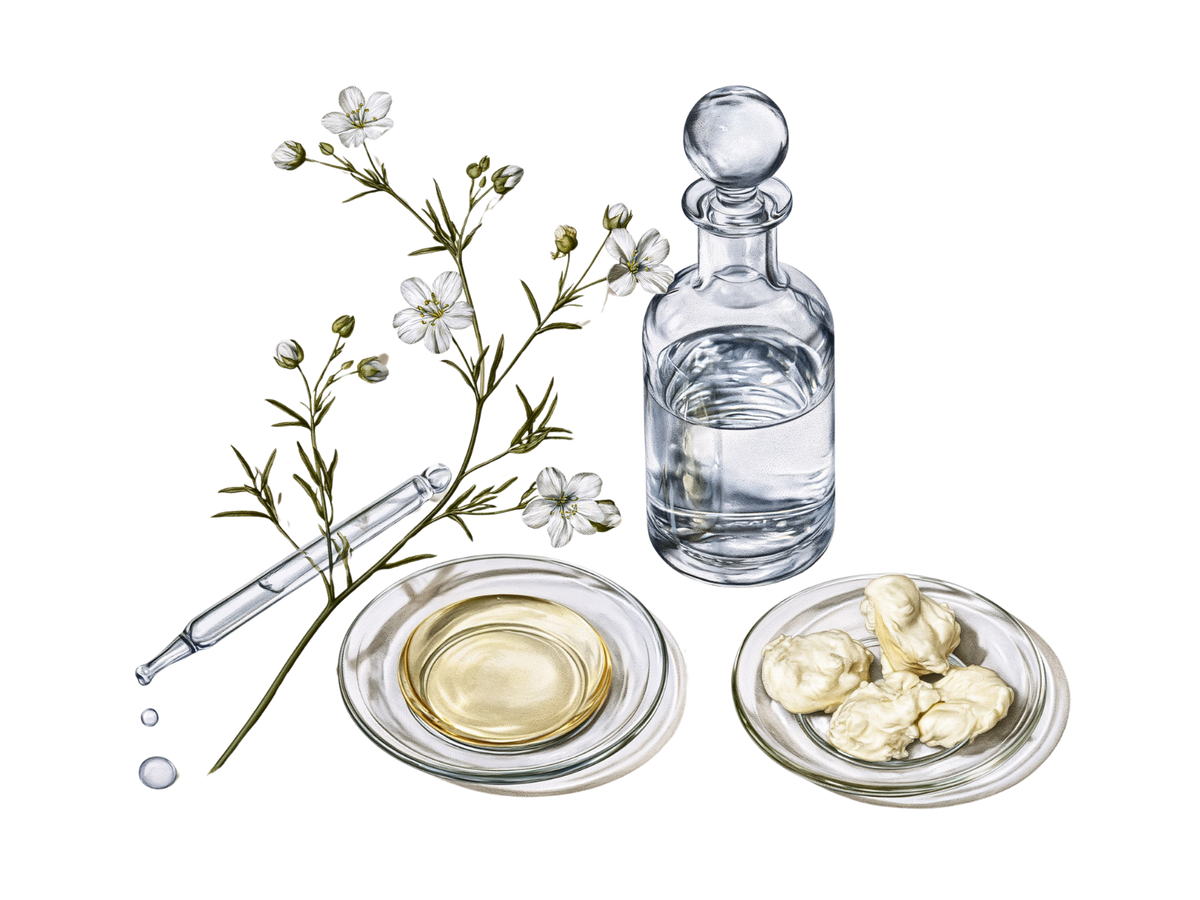
Botanical oils do not all age at the same pace. Some are naturally quite stable, while others are more delicate. Learn why an oil’s natural composition matters, what speeds oxidation, and how simple storage choices can help protect the oils you use.
Volume 2 · No. 006
Estimated reading time: 5 minutes
If you use botanical oils regularly, you may have noticed something curious: they do not all seem to age at the same pace.
One bottle may stay beautifully fresh for a long time, while another begins to change sooner. Its scent may become a little heavier or sharper. The color may shift. Something about it simply seems different from when you first opened it.
It is easy to assume that the longer-lasting oil must be the “better” one.
But botanical oils are not all built the same way. Some are naturally quite steady. Others are more delicate from the beginning.
That difference has much more to do with the plant itself than with whether the oil was good quality in the first place.
Some oils are naturally more delicate
Every botanical oil has its own natural makeup.
Some contain more of the components that tend to stay stable over time. Others contain more of the components that react readily with oxygen. Those more delicate oils can begin changing sooner, even when they were fresh and well made when bottled.
You do not need to know the names of all the different fatty acids to understand the basic idea. What matters is that the balance is different from plant to plant.
That is why “plant oil” does not really tell you very much by itself.
Meadowfoam seed oil, for example, is known for being unusually stable. Jojoba is another interesting case: although we usually call it an oil, it is technically a liquid wax, which helps explain why it behaves differently from many familiar seed oils.
Other beautiful botanical oils are simply more sensitive to age.
None of this makes one inherently better than another. They just have different personalities.
What actually happens as an oil ages?
Over time, oxygen slowly reacts with parts of an oil.
That process is called oxidation, but the everyday signs are much easier to recognize than the scientific term makes them sound.
The oil may begin to smell different. Its color can shift. Its once-fresh character may become duller, heavier, or sharper.
How quickly that happens depends partly on the oil itself and partly on what happens to it after bottling.
Heat can speed the process. So can repeated exposure to strong light. Air matters too, which is why a bottle that is opened and closed for months has a different life from one that remains sealed.
In other words, an oil’s shelf life is not determined by one thing.
Its natural composition sets the stage, but storage and handling help decide how quickly the story unfolds.
Plants bring some of their own protection
Botanical oils are also more complex than they may look in the bottle.
Along with their fatty acids, many naturally contain small amounts of tocopherols, plant pigments, sterols, and other compounds. Some can help slow oxidation.
The amount varies considerably from one oil to another.
Growing conditions, the particular plant variety, the part of the plant being pressed, and the way the oil is processed can all influence what eventually ends up in the bottle.
This helps explain why an oil’s stability cannot always be predicted by one simple characteristic.
Processing matters too.
An oil may be cold pressed, expeller pressed, filtered, refined, deodorized, or treated in other ways before it reaches the finished product.
Those choices can affect its scent, color, character, and stability.
So “less processed” does not automatically mean better, just as refined does not automatically mean worse. They are simply different materials, and the right choice depends on what the formulator wants that oil to contribute.
Delicate does not mean inferior
This may be the most important part.
An oil that does not stay fresh as long is not necessarily a lesser oil.
Some wonderful botanical oils are naturally more delicate. They may have a beautiful skin feel, an interesting botanical profile, or qualities that make them worth using even though they require a little more care.
A formulator may reach for a naturally stable oil in one product and choose a more delicate one in another.
This is also part of what makes a blend of oils interesting.
Different oils bring different textures, different characteristics, and different degrees of stability. A thoughtful blend can take advantage of those differences rather than expecting one oil to do everything.
The goal is not simply to choose whichever oil lasts the longest.
It is to understand what each one brings.
How you store an oil still matters
Once an oil reaches your home, a few ordinary habits can help protect it.
Heat and strong light are not especially kind to botanical oils, particularly over long periods. Storing them away from sunny windows, hot cars, radiators, or other places where they repeatedly become warm is a sensible precaution.
This applies whether the oil comes in dark glass, clear glass, or another type of packaging.
Clear glass can be especially beautiful when the oil itself has a lovely natural color, but it does not make the oil immune to light. A clear bottle is still best kept away from prolonged direct sunlight and strong heat.
Closing the cap or dropper after use also helps limit unnecessary exposure to air.
None of this requires treating your skincare like a laboratory sample. A bathroom cupboard, vanity away from a sunny window, or other reasonably cool place is usually far kinder than leaving a bottle where it spends hours in bright sun.
And your own senses can be useful.
Botanical oils naturally vary a little in color and aroma, and small differences between batches are not automatically cause for concern. But if a product begins to smell noticeably different from when it was fresh, that change is worth paying attention to.
Freshness is part of what makes botanical oils interesting
We usually talk about botanical oils in terms of where they come from, how they feel on the skin, or why a particular plant is interesting.
Their natural stability is another part of the story.
Some oils are steady and long-lasting. Others are a little more temperamental. Some need more protection from heat, light, and air than others.
That does not make the delicate ones less worthwhile.
It simply reminds us that botanical oils are not interchangeable ingredients. Each carries something of the plant that produced it—including the way it ages.
And sometimes, understanding that makes a bottle of oil a little more interesting than it looked at first.
Notes & Sources
Syed, A. “Oxidative Stability and Shelf Life of Vegetable Oils.” Oxidative Stability and Shelf Life of Foods Containing Oils and Fats, AOCS Press, 2016. Comparative discussion of fatty-acid composition and oxidative stability.
Redondo-Cuevas, L., Castellano, G., Torrens, F., & Raikos, V. “Revealing the relationship between vegetable oil composition and oxidative stability: A multifactorial approach.” Journal of Food Composition and Analysis, 2018. Examines the influence of fatty acids, tocopherols, phenolic compounds, pigments, and other components on oil stability.
Food Chemistry: X. “Vegetable oil oxidation: Mechanisms, impacts on quality, and approaches to enhance shelf life,” 2025. Review of oxidation and environmental factors that affect oil stability.
Continue Exploring
Rowan & Thistle Journal
- What Does Oil Actually Do for Your Skin?
- What Makes Plum Kernel Oil So Interesting for Skin?
- Why Some Oils Absorb Quickly While Others Feel Greasy
- Why Isn’t Every Facial Oil Just One Ingredient?
The Rowan & Thistle Herbarium
- Explore individual botanical oils and the plants from which they come.