

The Journal
Why Isn't Every Facial Oil Just One Ingredient?
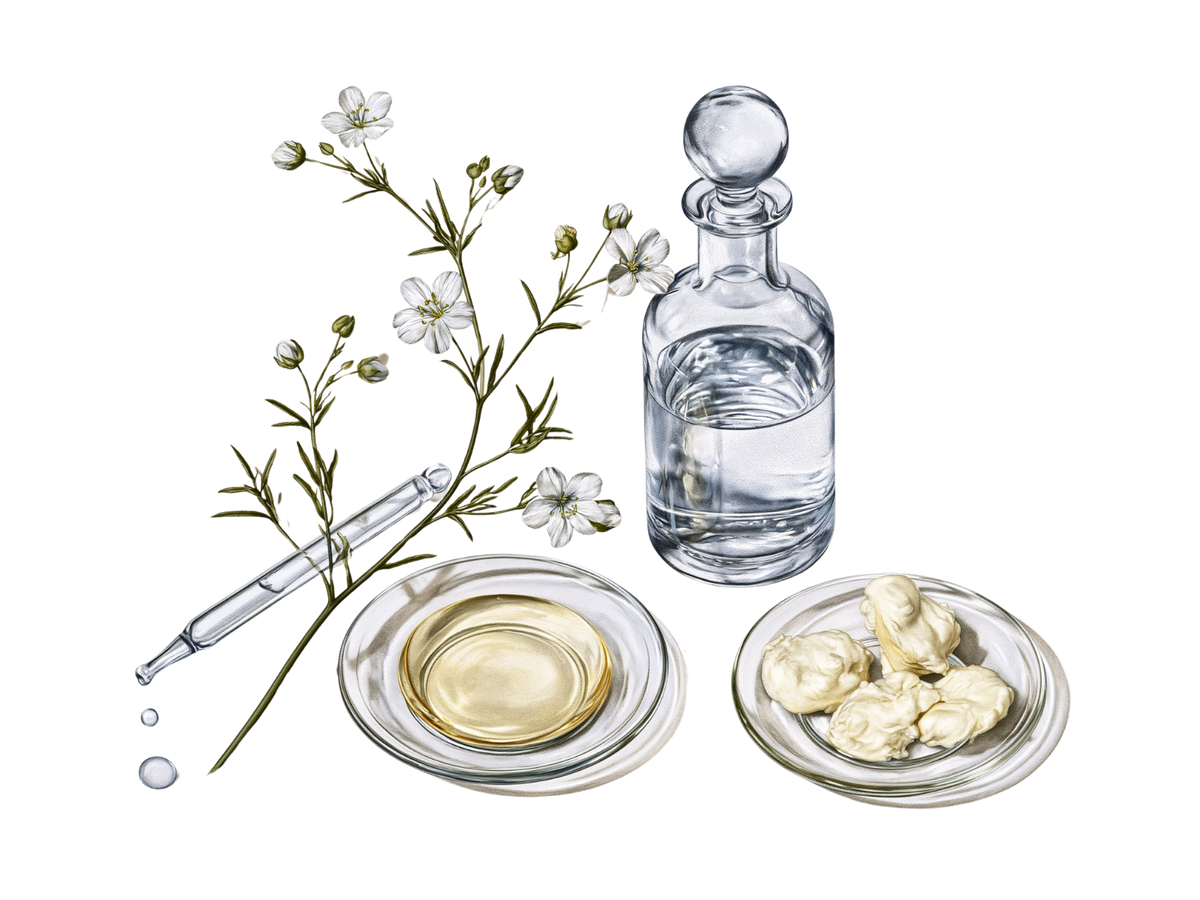
A facial oil can be made from one beautiful botanical oil. So why blend several? The answer is not about adding more for the sake of more. It is about using different oils deliberately to balance skin feel, stability, fatty-acid profiles, and the character of the finished formula.
VOL. 1 | NO. 010
Estimated reading time: 4 minutes
A bottle containing one beautiful plant oil can be appealing. It feels simple and easy to understand: one ingredient, one purpose, nothing extra.
So why do many facial oils contain several oils instead of just one?
Because different plant oils bring different qualities to the skin—and they can feel remarkably different when you use them. One may be light and quick-spreading. Another may feel richer and more cushioning. One may contribute a particular fatty-acid profile, while another brings naturally occurring compounds found only in smaller amounts.
A good blend is not about piling on ingredients. It is about combining carefully chosen materials so the finished oil feels balanced, wears well, and does what the formulator intended.
A plant oil is already more complex than it looks
An ingredient list that says only “plum kernel oil” or “jojoba oil” may look beautifully simple, but the ingredient itself is not chemically simple.
Plant oils contain mixtures of fatty acids and smaller amounts of naturally occurring compounds such as sterols, tocopherols, carotenoids, or other unsaponifiable (unable to be turned into soap) materials. Those proportions vary from one botanical source to another.
A single-oil facial product can be perfectly functional. But it will always reflect the strengths, limitations, texture, and stability profile of that one oil.
Different oils bring different kinds of balance
Some botanical oils are richer in oleic acid. Others contain more linoleic acid. Some are naturally more resistant to oxidation, while highly unsaturated oils can be more delicate. Research on topical plant oils also suggests that fatty-acid composition can influence how an oil interacts with the outer skin barrier.
Botanical oils are not interchangeable.
Blending lets a formulator work with those differences. A stable base oil can support a more delicate oil chosen for its composition or skin feel. A richer oil can be balanced with one that spreads more easily. The point is not variety for its own sake. It is control.
Skin feel matters more than it gets credit for
The product also needs to feel good enough that you actually want to use it.
Some oils have a slow, rich glide. Others spread almost instantly. Some leave a noticeable cushion, while others feel comparatively dry or silky. Ingredient choice can significantly change spreadability and sensory feel.
An oil that feels lovely for ten seconds but leaves you uncomfortably greasy later may not be a successful formula. Neither is one that disappears so quickly that dry skin still feels wanting.
A blend gives the formulator more control over that middle ground: enough richness to feel comforting, but still easy to spread and pleasant to wear.
Not every oil in the bottle has the same job
One oil may form much of the base because it has the right stability and skin feel. Another may be present in a smaller amount because it adds something distinctive: a different fatty-acid balance, a particular botanical fraction, or a richer finish.
A six-ingredient facial oil is not automatically more sophisticated than a one-ingredient oil. It may be better designed—or it may simply contain unnecessary additions. But the opposite is also true: a very short ingredient list does not tell you whether the finished product has been optimized for balance, stability, or skin feel.
The more useful question is whether each ingredient has a reason to be there.
Formulating is partly about removing things, too
It is surprisingly easy to build a facial oil that sounds wonderful on paper. There are dozens of appealing botanical ingredients available.
The harder work is editing.
At Rowan & Thistle, we think about facial oils as a composition rather than a collection. Does one ingredient improve the feel? Does another add something meaningfully different? Are two oils doing essentially the same thing? Is an interesting ingredient useful here, or is it only making the label longer?
That restraint matters because a thoughtful formula should not need a crowded ingredient list to justify itself. But restraint does not necessarily mean using only one oil. Sometimes the most elegant formula uses several ingredients precisely because each one contributes something the others do not.
Why blends often make more sense
For a formulator, the appeal of a blend is not that multiple oils sound more luxurious. It is that a blend creates more opportunities to fine-tune the finished product.
You can adjust richness without making the formula too heavy. You can improve glide without losing cushion. You can balance a beautiful but oxidation-prone oil with more stable companions. You can combine oils with different fatty-acid profiles instead of depending on one botanical source to do everything well.
That does not make a single oil “wrong.” It simply means it is one very specific solution. A blend gives the formulator more room to create a facial oil with a deliberate balance of feel, stability, and performance.
The ingredient count is not the formula
It is tempting to treat a short ingredient list as proof of quality. Sometimes it is a sign of thoughtful restraint. Sometimes it simply means the product has one ingredient.
The same is true in reverse: a facial oil containing several botanical oils is not necessarily overcomplicated.
What matters is the reasoning behind the formula. Every ingredient should contribute something useful, and the finished blend should feel more considered than a random collection of fashionable oils.
A well-designed facial oil should have a clear point of view: how rich it should feel, how quickly it should spread, how it should settle on the skin, and how the ingredients support one another.
The number is less important than whether each one earns its place—and whether the finished formula is better because they are working together. That is where formulation becomes more than simply choosing a beautiful oil and putting it in a bottle.
Notes & Sources
A review of vegetable oils and butters used on skin describes substantial differences in fatty-acid profiles and minor constituents among botanical oils and notes that their effects can vary with the individual oil, skin condition, frequency of use, and study design.
Current research also continues to examine the role of specific fatty acids, including linoleic acid, in skin-barrier function while emphasizing that more clinical research is needed before broad conclusions are made.
Studies of cosmetic emollients have demonstrated measurable differences in spreadability and sensory properties, supporting the practical importance of oil and emollient selection in determining how a finished product feels during application.
Continue Exploring
Botanical Field Guide: Explore the individual plant oils behind Rowan & Thistle formulations.
Related Journal Articles:
- What Does Oil Actually Do for Your Skin?
- Why Do Some Oils Absorb Quickly While Others Feel Greasy?
- Can Facial Oils Clog Pores?
- What Makes Plum Kernel Oil So Interesting for Skin?
- Meadowfoam Seed Oil: What Makes This Oregon-Grown Oil Different?