

The Journal
Does Natural Mean Gentle?
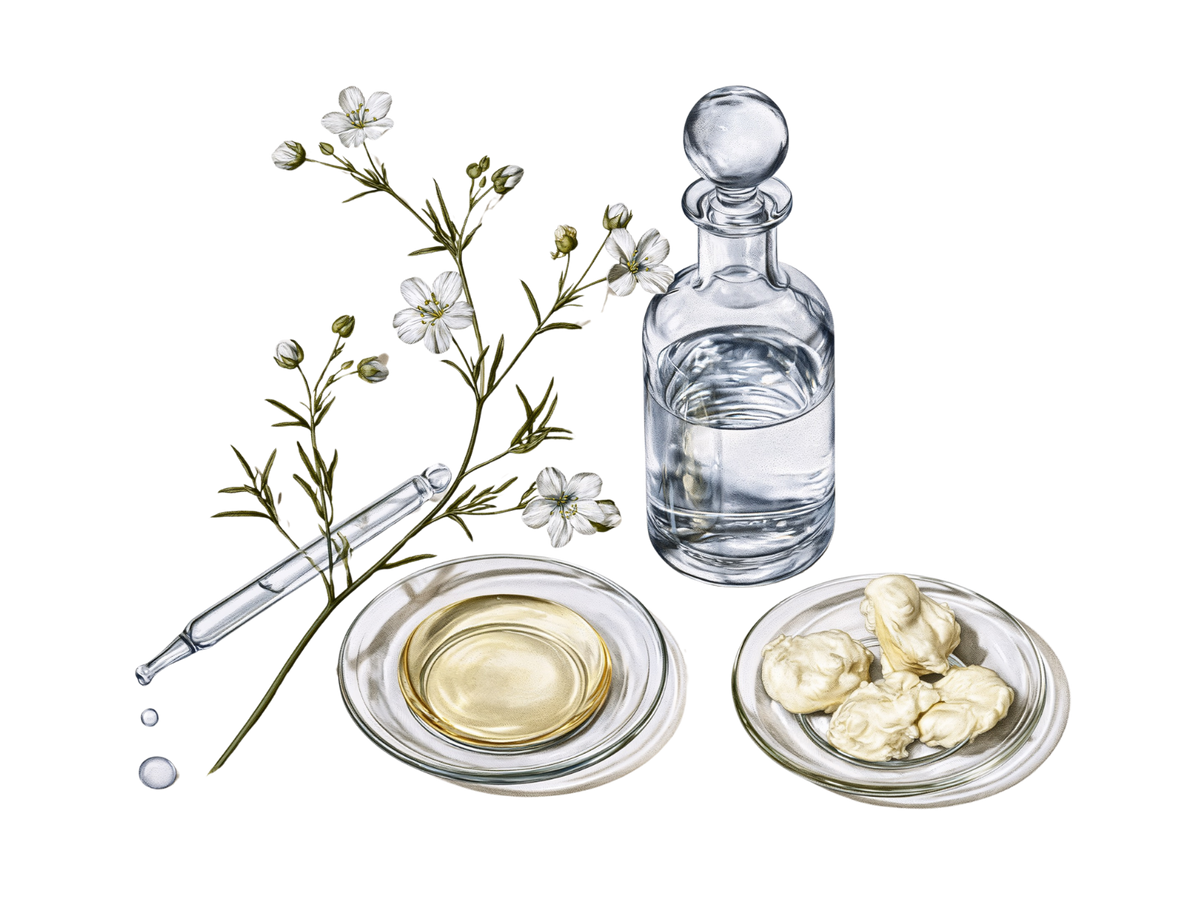
Natural ingredients can be beautiful, useful, and gentle—but “natural” alone cannot tell you how your skin will respond. Here is why the finished formula, concentration, fragrance, exposure, and your own skin matter more than whether an ingredient began in a plant or a laboratory.
Vol. 1 | No. 008
Estimated reading time: 5 minutes
“Natural” can be a reassuring word on a skincare label. It suggests plants, recognizable ingredients, fewer industrial-sounding names, and perhaps a product that will be kinder to skin that has already objected to plenty of other things.
But natural and gentle are not interchangeable.
That does not make “natural” meaningless, nor does it mean botanical ingredients are somehow suspect. Many plant oils, waxes, butters, extracts, and aromatic materials can be useful and beautiful ingredients. It simply means their origin cannot tell us, by itself, how skin will respond.
Natural tells you where something came from. Gentle is about what happens when you use it.
Plants are chemistry, too
It is easy to think of a plant ingredient as simpler than a laboratory-made one. Often, the opposite is true. A single essential oil, for example, may contain many naturally occurring aromatic compounds. A botanical extract can carry a whole collection of substances produced by the plant.
Those compounds are still chemistry. Some are soothing or useful. Some contribute scent, color, texture, or antioxidant activity. Some may irritate certain skin or trigger an allergic reaction in someone who has become sensitized to them. Botanical extracts have been documented as causes of contact dermatitis in susceptible people, just as ingredients from other sources can be.
Essential oils make the point especially well. Their natural origin does not prevent them from causing irritation or allergic contact dermatitis. Some citrus-derived materials can also increase sensitivity to sunlight, depending on the particular oil and how it was produced. Familiar fragrance components such as limonene and linalool can change as they are exposed to air; their oxidized forms can be more likely to cause contact allergy.
None of that means essential oils are automatically “bad.” It means they deserve the same thoughtful evaluation as any other active, fragrant, or complex material.
“Synthetic” does not automatically mean harsh, either
The reverse assumption causes just as much confusion.
An ingredient made or refined in a laboratory is not automatically aggressive or unsuitable for sensitive skin. Sometimes a highly purified or carefully manufactured ingredient is chosen precisely because its composition is predictable.
This is one reason ingredient debates can become unhelpful so quickly. “Natural versus synthetic” sounds like a useful dividing line, but skin does not read labels that way. The FDA specifically cautions consumers not to assume that ingredients are safer simply because they come from natural or organic sources.
The better questions are more practical: What is the ingredient? How much is used? Is the product rinsed away or left on? What else is in the formula? Is the ingredient likely to irritate or sensitize at the amount used? And what condition is your skin in when you apply it?
Even water can irritate skin when exposure is frequent enough. That is a good reminder that gentleness rarely belongs to one ingredient in isolation.
Gentleness belongs to the whole formula
Imagine two products that both contain the same fragrant botanical. One uses a small amount in a rinse-off cleanser. The other uses considerably more in a leave-on facial product. The ingredient name may look identical on both labels, yet the exposure is not.
The rest of the formula matters, too.
A cleanser can be made with plant-derived ingredients and still leave skin feeling tight if the cleansing system is too aggressive for that person. A facial oil can be entirely botanical and still be a poor fit for someone who reacts to one of its aromatic extracts. A product containing a laboratory-made ingredient may feel exceptionally comfortable because the finished formula is well balanced and intentionally restrained.
This is also why a long ingredient list is not automatically harsher than a short one. A ten-ingredient formula is not gentle merely because the label is brief, and a longer formula is not problematic simply because it contains more unfamiliar names.
The finished product—and the decisions behind it—matter more than the romance of the label.
Natural can still be a meaningful choice
There are perfectly good reasons to value botanical and naturally derived ingredients.
You may prefer plant oils for their fatty-acid profiles and sensory qualities. You may enjoy the natural color or subtle scent of an unrefined material. You may care about how an ingredient is grown, processed, sourced, or used within a lower-water product format. A formulator may choose a botanical because it brings a particular combination of texture, feel, and function that fits the product beautifully.
Those are real reasons. They simply are not the same as saying, “natural is safer.”
At Rowan & Thistle, that distinction matters. We are drawn to botanical and nature-derived materials, but we do not use “natural” as proof that an ingredient is appropriate for sensitive skin. The more useful question is whether a material earns its place in the formula—and whether the finished product remains thoughtful about concentration, fragrance, exposure, and the skin it is intended to meet.
That is less tidy than a green leaf on a label. It is also more useful.
A better way to read the front of the bottle
When you see “natural,” “botanical,” or similar language, let it tell you something about the maker’s ingredient philosophy—not everything about how the product will behave.
Then turn the bottle around.
Look at the full ingredient list. Pay attention to fragrance if your skin has reacted to scented products before. Consider whether the product will stay on your skin or rinse away. Be cautious about assuming that an ingredient you recognize from a garden, kitchen, or essential-oil cabinet must be mild simply because it is familiar.
And if your skin repeatedly burns, itches, swells, or develops a rash after certain products, that has moved beyond a marketing-language question. A dermatologist can help distinguish irritation from allergic contact dermatitis and, when appropriate, use patch testing to look for specific allergens.
Natural skincare can be gentle. It can also be effective, elegant, and genuinely enjoyable to use. The important word in that sentence is can.
Gentleness is not bestowed by origin. It is something a formula has to earn.
Notes & Sources
U.S. Food & Drug Administration. Using Cosmetics Safely and Product Testing of Cosmetics. The FDA notes that the source of an ingredient does not determine its safety and that “natural” is not a guarantee of safety.
U.S. Food & Drug Administration. Aromatherapy. Information on potential irritation, allergic reactions, and photosensitivity associated with some plant-derived aromatic materials.
American Academy of Dermatology. Contact Dermatitis Causes. Discussion of irritation and allergic contact dermatitis, including reactions associated with natural skincare products and fragrance.
DermNet. Allergic Contact Dermatitis to Essential Oils and Contact Allergy to Hydroperoxides of Limonene and Linalool.
Kiken DA, Cohen DE. “Contact Dermatitis to Botanical Extracts.” American Journal of Contact Dermatitis. 2002;13(3):148–152.
Continue Exploring
Vol. 1, No. 001 — Why Does Skincare Sting, Even When It Says Gentle?
Vol. 1, No. 002 — How to Read a Skincare Ingredient List