

The Journal
Meadowfoam Seed Oil: What Makes This Oregon-Grown Oil Different?
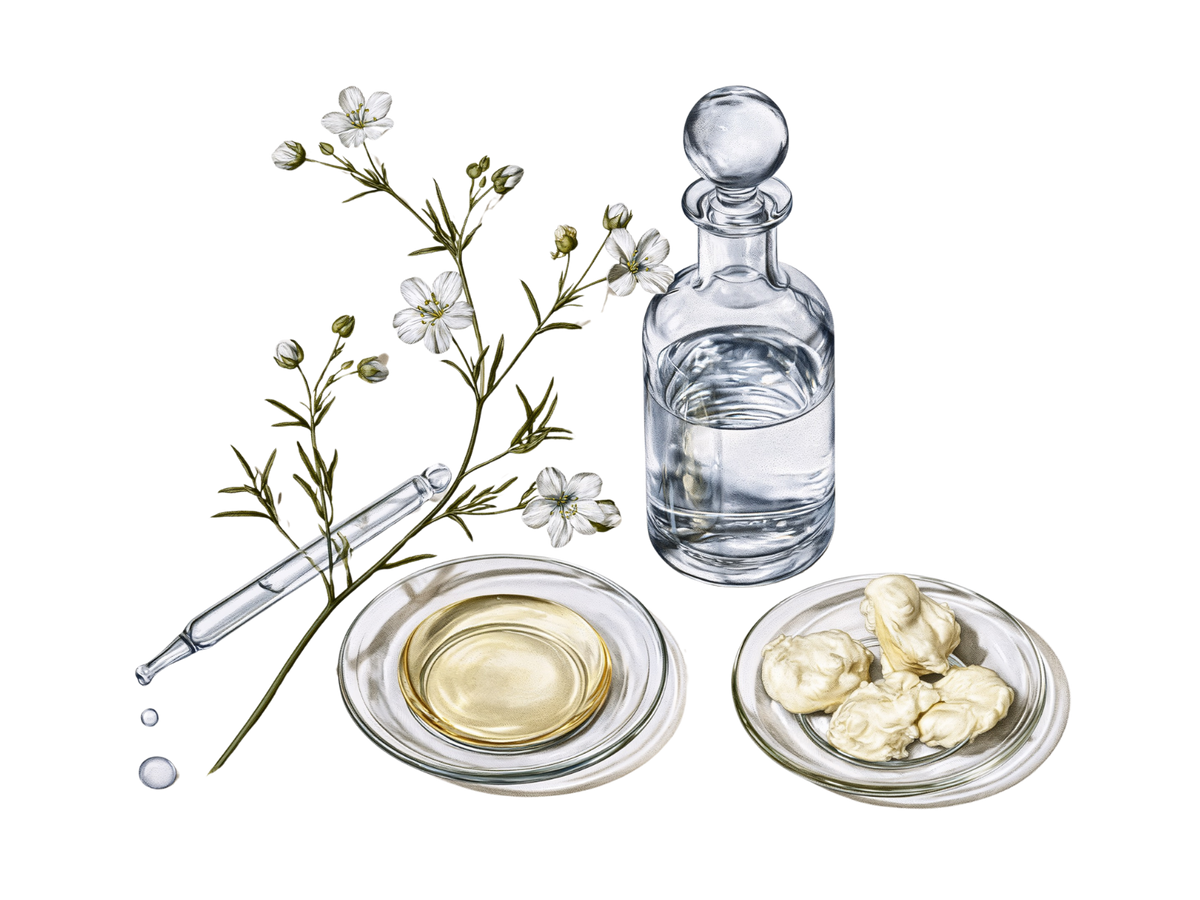
Meadowfoam seed oil looks unassuming, but its chemistry is anything but ordinary. Grown as a specialty crop in Oregon’s Willamette Valley, this pale botanical oil contains an unusual group of long-chain fatty acids that help give it exceptional oxidative stability and a distinctive place in skincare.
ROWAN & THISTLE JOURNAL
Vol. 1, No. 009
Estimated reading time: 5 minutes
If you have ever looked at a bottle of facial or body oil and wondered why one formula feels silky while another feels heavy, or why some oils seem to stay fresh longer than others, meadowfoam seed oil is a good reminder that “plant oil” is not one single category.
Oils can look similar in a bottle and behave very differently on skin. Their fatty acids—the building blocks that make up much of an oil—vary from plant to plant. Meadowfoam seed oil is especially interesting because its fatty-acid pattern is unusual enough to set it apart from more familiar seed oils.
There is also a distinctly Pacific Northwest story behind it. Meadowfoam, Limnanthes alba, is native to parts of southern Oregon and northern California, and Oregon researchers spent decades turning a little-known wildflower into a specialty oilseed crop suited to the Willamette Valley.
A Small White Flower With Unusual Chemistry
Meadowfoam gets its name from the appearance of its flowers. In bloom, low-growing plants can cover a field with creamy white flowers that resemble foam across a meadow.
The seed is the valuable part for skincare. When the seeds are pressed, they yield an oil made largely from very long-chain fatty acids—primarily fatty acids with 20 or 22 carbon atoms. Many familiar plant oils are dominated by somewhat shorter C16 and C18 fatty acids instead.
That difference sounds like chemistry for chemistry’s sake until you see what it changes.
Meadowfoam’s distinctive fatty acids give the oil remarkable resistance to oxidation. In practical terms, oxidation is part of what causes oils to develop stale or rancid odors and gradually lose quality. All oils can eventually oxidize, but they do not do so at the same rate. Meadowfoam is among the more oxidation-resistant plant oils studied, which is one reason formulators value it in products expected to remain pleasant over time.
That does not make a finished product indestructible. Light, heat, air exposure, packaging and the other ingredients in a formula still matter. But the oil itself brings an unusually stable foundation.
Stability Is Only Part of the Story
It would be easy to make meadowfoam sound like an ingredient chosen mainly to help a product sit nicely on a shelf. That misses the more interesting reason it works so well in skincare.
Meadowfoam is an emollient. It spreads across the skin, softens the surface and helps reduce the rough, dry feel that can make skin seem papery or uncomfortable. Like other oils, it can also help slow some water loss from the skin surface.
What makes meadowfoam appealing is the combination of that emollient character with its distinctive feel. It can give an oil blend a smooth, cushioned slip without necessarily making the entire formula feel dense or greasy. Much of that experience depends on what meadowfoam is blended with, so it is better to think of it as part of a well-designed texture than as an oil that always feels one particular way.
There is some human research suggesting that formulas containing meadowfoam seed oil can improve measurements of skin hydration and transepidermal water loss. The evidence is still much smaller than the mythology that sometimes grows around botanical oils, however. Meadowfoam is better understood as a very useful emollient than as a treatment ingredient with dramatic stand-alone claims.
Oregon Did Not Simply Happen to Grow It
Meadowfoam’s Oregon connection is unusually well documented. USDA researchers first became interested in the oil in the mid-20th century because of its unusual chemistry. Oregon State University researchers, working with growers and industry, then spent years developing cultivars and production methods that would allow meadowfoam to become a practical agricultural crop.
It turned out to fit the Willamette Valley especially well. Meadowfoam is a winter annual, tolerates some of the valley’s poorly drained soils and can serve as a rotation crop in areas long associated with grass-seed production.
That history matters because “locally grown” can otherwise become a vague piece of marketing language. In this case, there is a real relationship between the plant, the region and decades of Oregon agricultural research.
It is still worth being precise. Growing an ingredient in Oregon does not automatically make it environmentally superior to every oil grown elsewhere. Farming inputs, yields, processing, transportation and land use all matter. The more defensible story is also the more interesting one: meadowfoam is a specialty crop with deep roots in Oregon agricultural research and a chemistry that gave growers a reason to cultivate it in the first place.
Why Formulators Keep Returning to It
For a formulator, meadowfoam occupies a useful middle ground. It brings softness and slip to the skin, yet its value is not based on fragrance, color or a dramatic botanical story. It earns its place quietly through structure and performance.
That is one reason we find it so useful at Rowan & Thistle. We work with several beautiful plant oils, and each brings something different. Plum kernel oil has a distinctive sensory character. Other oils contribute their own fatty-acid patterns, colors or textures. Meadowfoam often plays a less obvious role: helping create an oil blend that feels polished while also contributing excellent oxidative stability.
That does not mean more meadowfoam automatically makes a better formula. A thoughtfully made oil is still a composition, and the balance among ingredients matters more than the reputation of any one of them.
Perhaps that is what makes meadowfoam especially fitting for Oregon. It is not flashy. The flowers are modest, the oil is pale, and most people have never heard of it. Yet beneath that quiet exterior is a plant chemistry unusual enough to inspire decades of research—and useful enough that this once-obscure wildflower became a crop in its own right.
Notes & Sources
Oregon State University Extension. Growing Meadowfoam in the Willamette Valley. Overview of Limnanthes alba, its unusual long-chain fatty-acid composition and its development as a Willamette Valley crop.
Oregon State University. New Oil Seed Crop Developed “From Scratch.” History of Oregon State University’s meadowfoam breeding and agricultural-development work.
Pollard, M.R. & Stumpf, P.K. Plant Physiology. Research describing the unusual C20 and C22 fatty acids found in meadowfoam seed oil.
Isbell, T.A., Abbott, T.P. & Carlson, K.D. Industrial Crops and Products. Research comparing the oxidative stability of meadowfoam with other vegetable oils.
Dąbrowska, M., Zielińska, A. & Nowak, I. Research evaluating meadowfoam seed oil in a cosmetic formulation, including skin hydration and transepidermal water-loss measurements.
Continue Exploring
What Makes Plum Kernel Oil So Interesting for Skin?
A closer look at another plant oil chosen as much for its character and sensory qualities as for its botanical origin.
Why Do Some Oils Absorb Quickly While Others Feel Greasy?
Explore why different plant oils can behave so differently once they meet your skin.
Can Facial Oils Clog Pores?
A more useful way to think about oils, pores and the limits of simple “comedogenic” labels.
The Rowan & Thistle Herbarium — Meadowfoam Seed Oil
Explore the botanical identity, origin and characteristics of Limnanthes alba in greater detail.